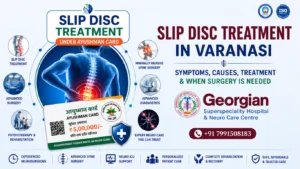
Slip Disc Treatment in Varanasi: Symptoms, Causes, Treatment & When Surgery is Needed
Key Takeaways
A slip disc (herniated disc) occurs when the soft inner cushion of a spinal disc pushes out through a crack, pressing on nearby nerves. Most patients recover with physiotherapy, rest, and medicines within 6–12 weeks. Surgery is needed only in severe cases — typically when nerve damage, extreme pain, or weakness in limbs does not respond to non-surgical treatment.
At Georgian Superspeciality Hospital and Neuro Care Centre, Chitaipur, Varanasi, our expert neurosurgeon Dr. Nandji Singh (MCh Neurosurgery) offers both advanced non-surgical care and minimally invasive spine surgery — giving patients across Varanasi, Jaunpur, Mirzapur, Chandauli, and Eastern UP access to world-class spine treatment close to home.
Introduction
Waking up with a sharp pain in your lower back that shoots down your leg — it’s one of the most disabling experiences a person can have. Whether you’re a working professional in Varanasi, a farmer from Chandauli, or a homemaker in Mirzapur, slip disc can affect anyone, at any age.
The good news? With timely diagnosis and the right treatment, most people with a slip disc recover fully — without surgery.
At Georgian Superspeciality Hospital and Neuro Care Centre, Chitaipur, Varanasi, our experienced neurosurgeons and spine specialists offer comprehensive slip disc treatment using the latest evidence-based methods — from conservative physiotherapy to minimally invasive spine surgery.
This guide is written to help you understand everything about a slip disc: what it is, why it happens, what you’ll feel, and what your treatment options are.
What Is a Slip Disc? (Simple Explanation)
Your spine is made up of bones called vertebrae, stacked on top of each other. Between each bone, there is a soft, rubbery cushion called an intervertebral disc. This disc acts like a shock absorber — it protects your spine and keeps your movements smooth.
Each disc has two parts:
- A tough outer ring (called the annulus fibrosus)
- A soft, gel-like centre (called the nucleus pulposus)
A slip disc — medically known as a herniated disc or prolapsed disc — happens when the soft inner material pushes through a tear or crack in the outer ring. This bulging disc can then press on nearby spinal nerves, causing pain, numbness, and weakness.
Slip disc most commonly occurs in two regions:
- Lumbar spine (lower back) — the most common location, often causing sciatica (pain that radiates down one or both legs)
- Cervical spine (neck) — causing neck pain, shoulder pain, and arm weakness
Why Does a Slip Disc Happen? Common Causes
Understanding the root causes helps in prevention and choosing the right treatment.
Age-related degeneration is the most common cause. As we age, the discs lose water content and become less flexible — making them more prone to cracking or tearing. This process, known as disc degeneration, can begin as early as the 30s.
Other common slip disc causes include:
- Heavy lifting with incorrect posture — A single wrong move while lifting something heavy can rupture a disc
- Sudden twisting or bending movements
- Prolonged sitting or desk work — especially with poor posture
- Being overweight or obese — extra body weight puts constant pressure on lumbar discs
- Genetics — some people are naturally predisposed to weaker disc material
- Smoking — reduces oxygen supply to disc tissue, accelerating degeneration
- Physically demanding jobs — construction workers, drivers, and daily wage labourers in Ghazipur, Sonbhadra, and Bhadohi are at higher risk
- Sedentary lifestyle — weak core and back muscles offer less spinal support
- Trauma or accident — a fall or road accident can directly rupture a disc
What Does a Slip Disc Feel Like? Recognising the Symptoms
Slip disc symptoms vary depending on which disc is affected and whether a nerve is being compressed.
Most common symptoms include:
- Lower back pain — dull, aching, or sharp; often worse on one side
- Sciatica — a burning or electric-shock pain that travels from the lower back through the buttock and down the leg (caused by lumbar disc herniation pressing on the sciatic nerve)
- Neck pain and shoulder pain — in cervical disc herniation
- Numbness or tingling — in the arm, leg, or foot, depending on the affected level
- Muscle weakness — difficulty lifting your foot, gripping objects, or climbing stairs
- Pain that worsens when sitting, coughing, or sneezing
- Pain that improves when lying down
In severe cases — especially when the disc presses on the central spinal canal — patients may experience:
- Loss of bladder or bowel control
- Weakness in both legs
- Difficulty walking
These last three are emergency warning signs and need immediate medical attention.
Warning Signs: When to Go to Emergency Immediately
If you or someone near you experiences any of these signs — do not wait for a routine appointment:
☑ Sudden loss of bladder or bowel control
☑ Severe weakness in both legs (unable to stand or walk)
☑ Loss of sensation in the groin or inner thighs (saddle anaesthesia)
☑ Rapidly worsening numbness or paralysis in arms or legs
☑ Extreme, unbearable back or neck pain following a fall or accident
These symptoms may indicate Cauda Equina Syndrome — a rare but serious spinal emergency requiring surgery within hours.
📞 Call Georgian Superspeciality Hospital Emergency: +91 79915 08183 (24×7)
How Is a Slip Disc Diagnosed?
If you are searching for slip disc treatment in Varanasi, the first step is an accurate diagnosis. Never rely on self-diagnosis or unqualified advice.
At Georgian Superspeciality Hospital, Dr. Nandji Singh follows a structured diagnostic process:
- Clinical Examination A detailed neurological exam to check reflexes, muscle strength, sensation, and walking pattern.
- MRI Scan (Gold Standard) Magnetic Resonance Imaging (MRI) provides the clearest picture of soft tissues, including discs and nerves. It shows exactly which disc is herniated, the degree of nerve compression, and the overall health of the spine.
- CT Scan Used when MRI is not possible or to get additional bony detail.
- X-ray Does not show disc herniation directly but helps rule out fractures, infections, or spinal alignment issues.
- Electromyography (EMG) / Nerve Conduction Study (NCS) Used to assess nerve function when there is significant weakness or numbness.
Slip Disc Treatment: Non-Surgical Options
Can a slip disc heal without surgery? Yes — in most cases.
Research consistently shows that 80–90% of slip disc patients improve with conservative, non-surgical treatment within 6 to 12 weeks. Surgery is reserved for specific situations that do not respond to these treatments.
Physiotherapy — The Cornerstone of Recovery
Physiotherapy is the most important non-surgical treatment for a slip disc. A trained physiotherapist will guide you through:
- Core strengthening exercises to take pressure off the spine
- Stretching and flexibility routines to reduce nerve tension
- Postural correction techniques
- Hot and cold therapy for pain relief
- Traction therapy in selected cases
Is physiotherapy enough for a slip disc? For most patients with mild to moderate herniation, yes — physiotherapy combined with rest and medication produces excellent results.
Medications
- NSAIDs (anti-inflammatory tablets) — reduce pain and swelling
- Muscle relaxants — relieve muscle spasms
- Nerve pain medications (such as pregabalin or gabapentin) — for burning or tingling pain
- Oral steroids — short courses in acute cases to rapidly reduce inflammation
Epidural Steroid Injections
For patients with severe sciatica or nerve pain, a guided steroid injection near the compressed nerve can provide significant relief and allow physiotherapy to progress. This is a minimally invasive pain management procedure done under image guidance.
Rest and Activity Modification
Bed rest for more than 1–2 days is not recommended. Patients are encouraged to stay gently active and avoid activities that worsen pain (heavy lifting, prolonged sitting, bending and twisting).
Safe Exercises for Slip Disc Patients
If you’re wondering what exercises are safe for someone with a slip disc, here are general guidelines (always confirm with your doctor first):
✅ Gentle walking
✅ Swimming (low-impact)
✅ Knee-to-chest stretches (lumbar)
✅ Cat-cow spine stretches
✅ Pelvic tilt exercises
❌ Avoid: heavy weight lifting, running on hard surfaces, sit-ups, high-impact sports, and extreme forward bending
When Is Slip Disc Surgery Needed?
This is one of the most common questions patients from Varanasi, Jaunpur, Mirzapur, and across Eastern UP ask when they come to us.
Surgery is recommended when:
- Conservative treatment fails after 6–12 weeks of consistent physiotherapy and medication
- Nerve damage is worsening — progressive weakness in the limbs despite treatment
- Cauda Equina Syndrome — immediate surgical emergency
- Severe, disabling pain that does not respond to any non-surgical treatment
- Significant neurological deficit — such as foot drop (inability to lift the foot)
Types of Slip Disc Surgery Available in Varanasi
At Georgian Superspeciality Hospital, Dr. Nandji Singh performs the following spine surgeries:
- Microdiscectomy (Most Common) A minimally invasive procedure where a small portion of the herniated disc pressing on the nerve is removed. Most patients are walking within 24 hours and discharged in 2–3 days.
- Endoscopic Discectomy A highly advanced, keyhole surgery technique using a thin camera (endoscope). Minimal muscle damage, faster recovery, and less post-operative pain.
- Spinal Fusion Used when multiple levels are involved or the spine is unstable after disc removal. Vertebrae are fused together with bone graft and implants.
- Artificial Disc Replacement In selected cases, the damaged disc is replaced with an artificial implant, preserving normal spinal movement.
Is minimally invasive spine surgery available in Varanasi? Yes. Georgian Superspeciality Hospital offers minimally invasive spine surgery led by Dr. Nandji Singh, making advanced spine care accessible right here in Eastern UP — without the need to travel to Delhi or Mumbai.
Surgical vs Non-Surgical Treatment: Quick Comparison
| Feature | Non-Surgical Treatment | Surgical Treatment |
| Who it’s for | Mild to moderate herniation | Severe or non-responsive cases |
| Duration | 6–12 weeks | 1–3 hour procedure |
| Recovery time | 4–12 weeks | 2–6 weeks (minimally invasive) |
| Hospitalisation | Not required | 2–3 days (microdiscectomy) |
| Success rate | ~80–90% improve | ~85–95% for well-selected patients |
| Pain relief | Gradual | Often immediate after surgery |
| Risk | Very low | Low with experienced surgeons |
Myths vs Facts About Slip Disc
Myth: Surgery is always needed for a slip disc. Fact: Most patients recover fully with physiotherapy and medication. Surgery is the last resort.
Myth: Slip disc means permanent disability. Fact: With proper treatment and physiotherapy, most patients return to normal life and work.
Myth: Bed rest is the best treatment. Fact: Prolonged bed rest can actually worsen slip disc symptoms. Guided movement and exercise are better.
Myth: Slip disc only happens in old age. Fact: Young adults in their 30s and 40s are commonly affected, especially those with desk jobs or physically demanding work.
Myth: Once you have a slip disc, it will always come back. Fact: With good posture, regular exercise, and a healthy weight, most patients do not experience recurrence.
Recovery After Slip Disc Treatment
What is the recovery time after slip disc treatment?
Recovery varies depending on the severity of the condition and the type of treatment:
- Non-surgical recovery: 6–12 weeks with consistent physiotherapy
- Microdiscectomy recovery: Walking within 24 hours, discharge in 2–3 days, return to light work in 2–4 weeks
- Spinal fusion recovery: 3–6 months with physiotherapy support
Recovery Tips After Slip Disc Treatment
✅ Follow your physiotherapy programme without skipping sessions
✅ Use a firm, supportive mattress
✅ Maintain a healthy weight — every extra kilogram adds pressure to your spine
✅ Avoid smoking — it slows disc healing
✅ Do not lift heavy objects until cleared by your doctor
✅ Use ergonomic chairs and maintain good sitting posture
✅ Walk daily as directed — it is the best natural spine medicine
✅ Keep all follow-up appointments
Prevention: How to Protect Your Spine
You cannot always prevent a slip disc, but you can significantly reduce your risk:
- Exercise regularly — especially core-strengthening and back exercises
- Lift correctly — bend at your knees, not your back
- Maintain a healthy weight
- Sit with good posture — avoid slouching for hours
- Take movement breaks — if you have a desk job, stand up every 30–45 minutes
- Quit smoking
- Stay hydrated — discs are made mostly of water
Meet Your Spine Specialist: Dr. Nandji Singh
If you are looking for a trusted spine specialist in Varanasi or an experienced neurosurgeon in Varanasi, Dr. Nandji Singh is the person many patients across Eastern UP, Bihar, and neighbouring districts turn to.
Dr. Nand Ji Singh
MCh Neurosurgery | Senior Consultant & Head of Neurosurgery
Georgian Superspeciality Hospital and Neuro Care Centre, Varanasi
Qualifications:
- MCh Neurosurgery (Highest Specialty Degree in India)
- MS General Surgery
- MBBS
- Fellowship in Advanced General Education (FAGE)
Experience: 15+ years in complex brain and spine surgery
Surgeries Performed: 500+ successful neurosurgical procedures
Patients Treated: 5,000+ across Eastern UP and Bihar
Languages Spoken: Hindi, English, Kannada, Telugu, Bhojpuri
Professional Memberships:
- Neurosurgical Society of India
- Skull Base Society of India
- AO Spine (International Spine Specialist Organization)
- Neurological Society of India
Areas of Expertise:
- Complex Spine Surgery (disc herniation, spinal stenosis, spinal tumours)
- Minimally Invasive Spine Surgery
- Brain Tumour Surgery
- Vascular Neurosurgery
- Epilepsy Surgery
- Neuro-Trauma Management
OPD Timings: Monday to Saturday | 11:00 AM – 2:00 PM
“After years of back pain affecting my work, I had minimally invasive spine surgery here. I was walking the next day! The care team was exceptional throughout.” — Sunita Devi Singh, Spine Surgery Patient, Mirzapur
Why Patients Choose Georgian Superspeciality Hospital for Spine Care
Patients from Varanasi, Chandauli, Ghazipur, Jaunpur, Mirzapur, Bhadohi, and Sonbhadra choose Georgian Superspeciality Hospital and Neuro Care Centre because:
- Expert Spine Surgeon — Dr. Nandji Singh with 15+ years of spine-specific experience
- Minimally Invasive Surgery — smaller incisions, faster recovery, less pain
- Dedicated Neuro ICU — 24×7 intensive monitoring post-surgery
- Advanced Diagnostics — MRI, CT, Nerve Conduction Studies available in-house
- Neuro-Navigation Technology — for precision surgery with minimal risk
- Ayushman Bharat Empanelled — cashless spine surgery available up to ₹5 lakhs for eligible patients
- Comprehensive Rehab — physiotherapy and recovery support post-surgery
- 24×7 Emergency Care — for trauma-related spinal injuries
- Affordable, Transparent Pricing — no hidden charges
Book Your Appointment
Don’t let back pain or nerve pain control your life. Whether you’re in Varanasi, Jaunpur, Ghazipur, or anywhere across Eastern Uttar Pradesh — expert slip disc treatment is now available close to home.
👉 Take the first step. Book a consultation with Dr. Nandji Singh today.
📞 Call / WhatsApp: +91 79915 08183 | +91 84003 02936
🌐 Website: gshri.com
📧 Email: info@gshri.com
📍 Address: Gokulpuram Colony, Chunar Road, Near Gautam Nagar, Chitaipur / Avleshpur, Varanasi – 221006
⏰ OPD: Monday to Saturday | 11:00 AM – 2:00 PM
🚑 Emergency: 24×7
💳 Ayushman Bharat, Star Health, United India, National Insurance & all major cashless insurance accepted
Share This Article
Help someone in pain find the right treatment. Share this article with your family and friends.
📘 Facebook: https://www.facebook.com/georgianshospital
📸 Instagram: https://www.instagram.com/georgianshospital/
🐦 Twitter/X: https://x.com/Georgianhosp
💼 LinkedIn: https://in.linkedin.com/in/georgian-hospital-570a62269?original_referer=https%3A%2F%2Fwww.google.com%2F
💬 WhatsApp:+91 79915 08183
Here are 15 high-impact FAQs for the Slip Disc blog — fully in English, with Hinglish only where naturally needed for local patient connect:
❓ Frequently Asked Questions — Slip Disc Treatment in Varanasi
Q1. What exactly is a slip disc?
A slip disc — medically called a herniated or prolapsed disc — occurs when the soft cushion between two spinal bones shifts out of place and presses on a nearby nerve. This pressure causes pain, numbness, or weakness in the back, legs, or arms depending on which disc is affected.
Q2. What are the most common symptoms of a slip disc?
The most common symptoms include lower back pain, shooting pain down one leg (sciatica), numbness or tingling in the foot or hand, muscle weakness, and pain that gets worse when sitting, coughing, or sneezing. In cervical (neck) slip disc, patients feel neck pain, shoulder pain, and arm weakness.
Q3. Can a slip disc heal without surgery?
Yes — in most cases it can. Around 80–90% of slip disc patients recover fully with physiotherapy, rest, and medications within 6 to 12 weeks. Surgery is only recommended when the pain is severe, nerve damage is worsening, or conservative treatment shows no improvement after several weeks.
Q4. Which doctor should I consult for a slip disc in Varanasi?
You should consult a neurosurgeon or spine specialist. At Georgian Superspeciality Hospital, Chitaipur, Varanasi, Dr. Nandji Singh (MCh Neurosurgery) specialises in both non-surgical and surgical slip disc treatment — with 15+ years of experience and 500+ successful spine procedures.
Q5. How is a slip disc diagnosed?
An MRI scan is the gold standard for diagnosing a slip disc. It clearly shows which disc is herniated, how much nerve compression is present, and the overall condition of the spine. A CT scan, X-ray, and nerve conduction study (NCS) may also be used depending on the case.
Q6. Is physiotherapy enough for a slip disc?
For mild to moderate slip disc, physiotherapy is often the most effective treatment. It strengthens the core muscles around the spine, reduces nerve pressure, and improves posture. However, physiotherapy works best when guided by a specialist — self-exercise without proper guidance can sometimes worsen the condition.
Q7. What exercises are safe for someone with a slip disc?
Safe exercises generally include gentle walking, knee-to-chest stretches, pelvic tilts, cat-cow spine stretches, and swimming. Heavy weight lifting, running on hard surfaces, and extreme forward bending should be strictly avoided. Always confirm with your doctor before starting any exercise routine.
Q8. What is the difference between a slip disc and sciatica?
A slip disc is the cause — it is the physical displacement of the spinal disc. Sciatica is the symptom — it is the pain that travels from the lower back through the buttock and down the leg when a herniated disc presses on the sciatic nerve. Many slip disc patients experience sciatica, but not all sciatica is caused by a slip disc.
Q9. When is slip disc surgery required?
Surgery is considered when: conservative treatment fails after 6–12 weeks, there is progressive nerve weakness or foot drop, bladder or bowel control is lost (Cauda Equina Syndrome — a medical emergency), or the pain is severe and disabling despite all non-surgical treatment.
Q10. Is minimally invasive spine surgery available in Varanasi?
Yes. Georgian Superspeciality Hospital and Neuro Care Centre, Varanasi offers minimally invasive spine surgery including microdiscectomy and endoscopic discectomy. These procedures involve smaller incisions, less pain, faster recovery, and shorter hospital stays compared to traditional open surgery — making world-class spine care available locally in Eastern UP.
Q11. What is the recovery time after slip disc surgery?
For microdiscectomy (the most common procedure), most patients are walking within 24 hours and discharged in 2–3 days. Return to light work typically takes 2–4 weeks. For spinal fusion, full recovery takes 3–6 months with physiotherapy support. Recovery time varies based on the severity of the condition and the patient’s overall health.
Q12. Can a slip disc come back after treatment?
A slip disc can recur, but the risk is significantly reduced with proper lifestyle changes — maintaining a healthy weight, doing regular core-strengthening exercises, practising correct posture, and avoiding heavy lifting with a bent back. Most patients who follow post-treatment guidelines do not experience recurrence.
Q13. Is slip disc treatment covered under Ayushman Bharat?
Yes. Georgian Superspeciality Hospital is empanelled under Ayushman Bharat Pradhan Mantri Jan Arogya Yojana (PMJAY). Eligible patients can avail cashless spine surgery treatment up to ₹5 lakhs. Patients from Varanasi, Chandauli, Ghazipur, Jaunpur, Mirzapur, Bhadohi, and Sonbhadra can directly come to our hospital with their Ayushman card for verification.
Q14. How do I know if my back pain is a slip disc or just a muscle strain?
Muscle strain pain is usually localised to the back and improves within a few days with rest. Slip disc pain is more intense, often radiates to the legs or arms, is accompanied by numbness or tingling, and does not improve quickly with rest alone. If your back pain persists beyond 2 weeks or spreads to your limbs, get an MRI done and consult a spine specialist.
Q15. How can I book an appointment for slip disc treatment in Varanasi?
You can book a consultation with Dr. Nandji Singh at Georgian Superspeciality Hospital, Chitaipur, Varanasi through any of the following:
📞 Call / WhatsApp: +91 79915 08183 | +91 84003 02936
📍 Location: Gokulpuram Colony, Chunar Road, Chitaipur, Varanasi – 221006
⏰ OPD: Monday to Saturday | 11:00 AM – 2:00 PM
🚑 Emergency: 24×7 Available